
 Editions
Triptych of the Resurrection
For Easter
Sizes
One object, sold whole: Musée du Louvre, Département des Peintures holds it as MI 247; MI 248; MI 249. 3 sheets, one edition, $349 — the printed panels hang level within 0.0%.
Send as a gift
A printed card goes in the parcel with your message and the work’s museum record. No price is shown anywhere in the parcel. Enter the recipient’s address at checkout.
0 / 240Have a gift certificate?
The certificate’s balance is applied at checkout; any remainder is paid there. Check a balance or buy one.
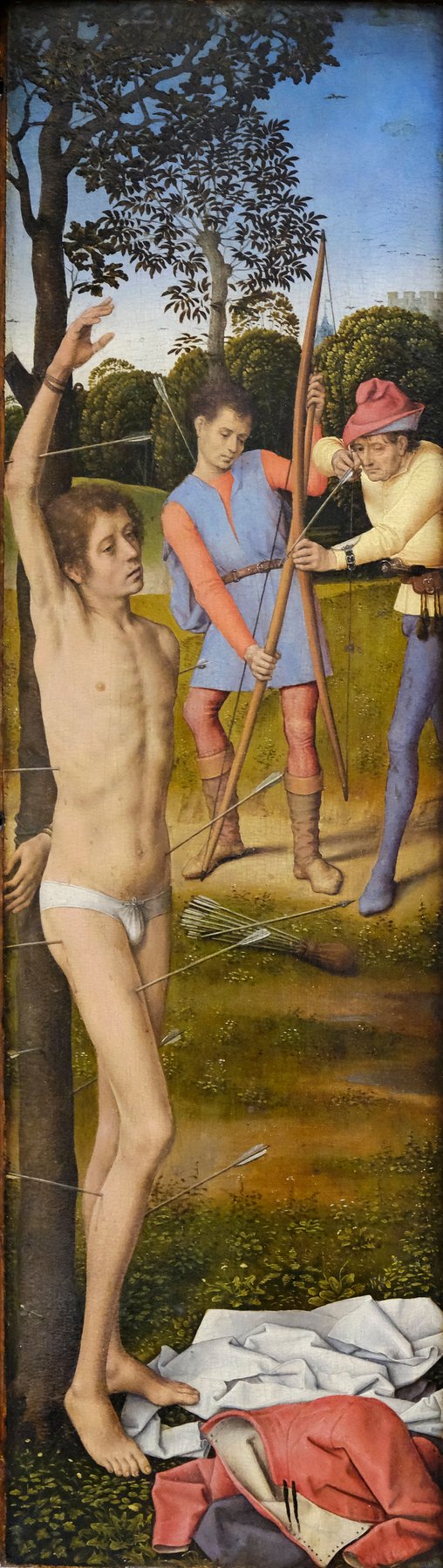
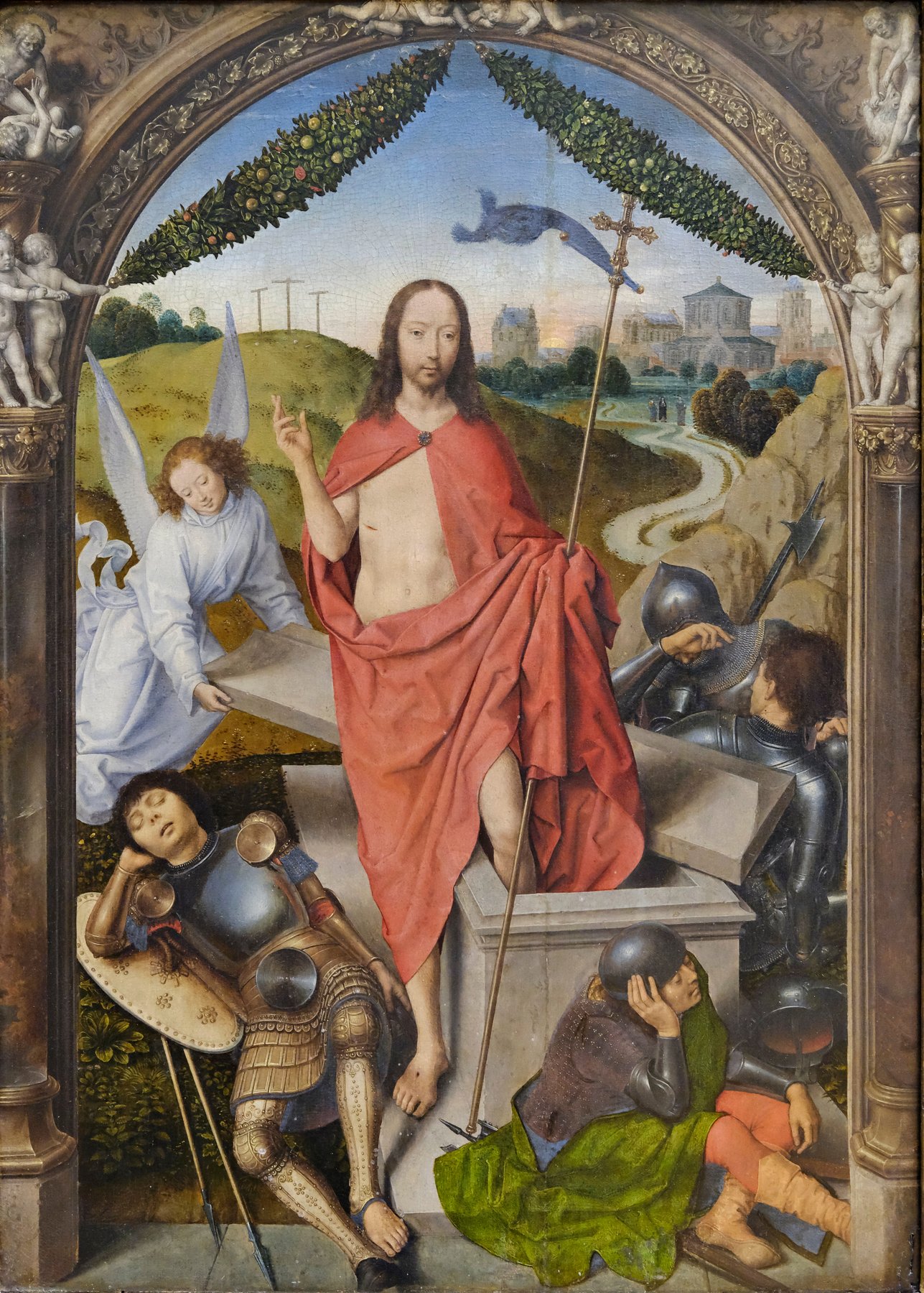
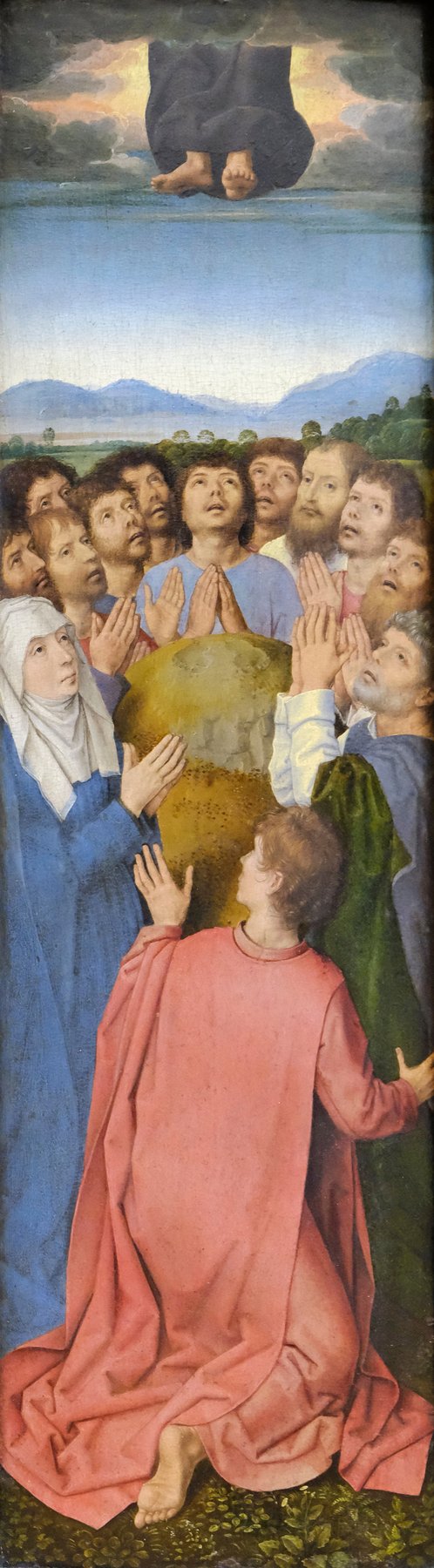
One of the soldiers at the tomb wears a polished helmet, and Guillaume Kazerouni, writing for the Louvre, points out that Christ is reflected in it. An angel swings the lid aside, and Christ steps out in a red mantle, blessing, a cross-staff with its banner in His other hand. Of the four guards, Kazerouni notes, two wake in terror; in front, one sleeps on and another holds his head in his hand. Over the tomb Hans Memling hangs Italian garlands and putti on an arched arcade, marks of a late work of about 1490, made for private devotion. One wing gives Sebastian, bound to a tree and shot with arrows. The other gives the Ascension, where only the hem of Christ's robe and His feet show at the top, beneath the cloud, a foreshortening Kazerouni calls surprising. The last thing seen of Him is His feet.
The panels hang in a row at one image height; the hung images measure about 30.6 in across, before any gap between frames.
| Held by | Musée du Louvre, Département des Peintures · MI 247; MI 248; MI 249 the museum’s record |
|---|---|
| Source file | Wikimedia Commons · Triptyque de la Résurrection - Hans Memling - Musée du Louvre Peintures MI 247; MI 248; MI 249.jpg |
| Licence | Public domain |
| Panel · left | Triptych of the Resurrection (left wing) — 1,685 × 5,970 px |
| Panel · centre | Triptych of the Resurrection (centre panel) — 4,292 × 6,002 px |
| Panel · right | Triptych of the Resurrection (right wing) — 1,647 × 5,952 px |
| Chain | Each panel taken from the source file above and cut to its own painted field; held as 3 print masters. |
Sources
Printed on demand as one edition. The whole image is printed on every sheet — never cropped to fit — so each panel carries an archival margin.