
 Editions
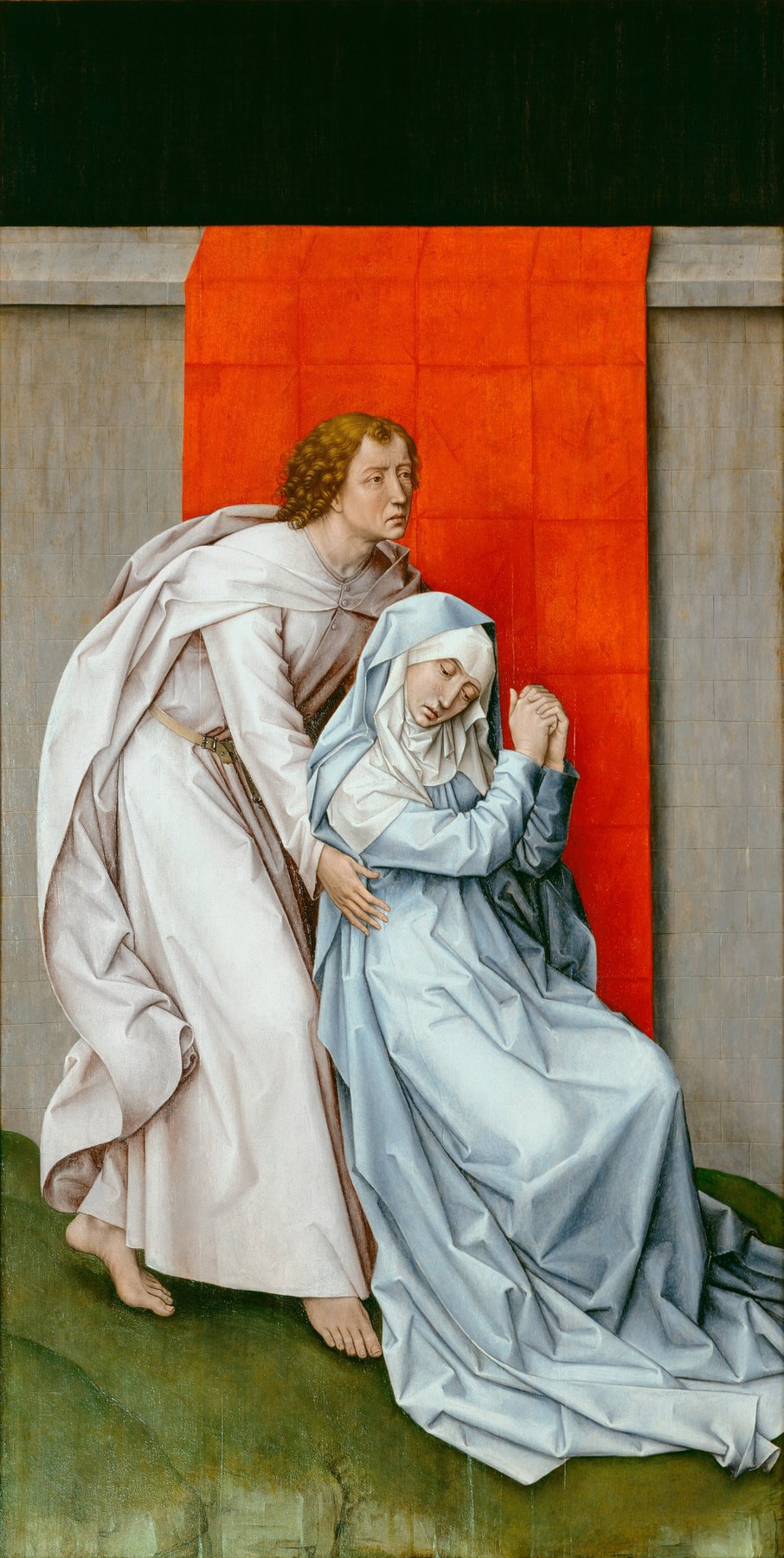
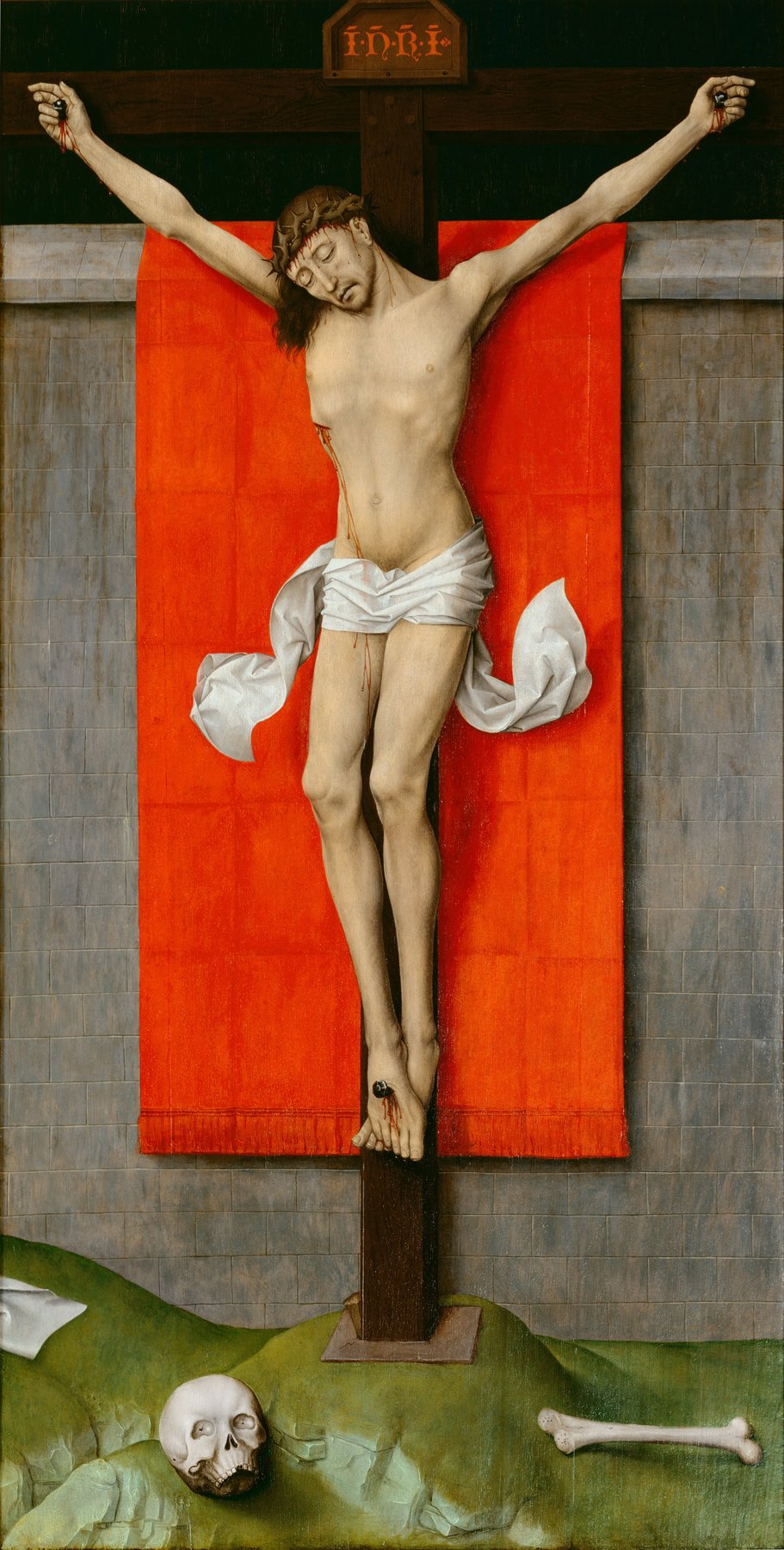
The Crucifixion, with the Virgin and Saint John the Evangelist Mourning
For Good Friday
Sizes
One object, sold whole, as Philadelphia Museum of Art shows it. 2 sheets, one edition, $229 — the printed panels hang level within 0.0%.
Send as a gift
A printed card goes in the parcel with your message and the work’s museum record. No price is shown anywhere in the parcel. Enter the recipient’s address at checkout.
0 / 240Have a gift certificate?
The certificate’s balance is applied at checkout; any remainder is paid there. Check a balance or buy one.
The hem of the Virgin's mantle slips across the seam into her Son's half. Rogier van der Weyden painted two boards, and the Web Gallery of Art notes that the trail of her mantle overlaps the right one; her grief does not keep to its own side. Our Lady swoons backward into Saint John's arms, her hands pressed together. Beside her Christ hangs against a red cloth of honour, like monumental sculpture, the same text says. The draperies are nearly grisaille, white with only light tints of pink and blue, and a high gray stone wall bars any landscape. At the foot of the Cross a skull and a thighbone mark Golgotha. Painted about 1460, the two boards were once the backs of the wings of a carved retable. John stands barefoot on the grass and holds her up.
The panels hang in a row at one image height; the hung images measure about 24.2 in across, before any gap between frames.
| Held by | Philadelphia Museum of Art (John G. Johnson Collection) the museum’s record |
|---|---|
| Source file | Wikimedia Commons · Rogier van der Weyden, Netherlandish (active Tournai and Brussels) - The Crucifixion, with the Virgin and Saint John the Evangelist Mourning - Google Art Project.jpg |
| Licence | Public domain |
| Panel · left | The Crucifixion, with the Virgin and Saint John the Evangelist Mourning (left panel) — 2,186 × 4,341 px |
| Panel · right | The Crucifixion, with the Virgin and Saint John the Evangelist Mourning (right panel) — 2,197 × 4,341 px |
| Chain | Each panel taken from the source file above and cut to its own painted field; held as 2 print masters. |
Printed on demand as one edition. The whole image is printed on every sheet — never cropped to fit — so each panel carries an archival margin.