

Drag the print to move it. The painting is shown at true scale; where its shape differs from the sheet the print has a paper border, not drawn here. Prints are sold unframed, and a frame here is only for planning.
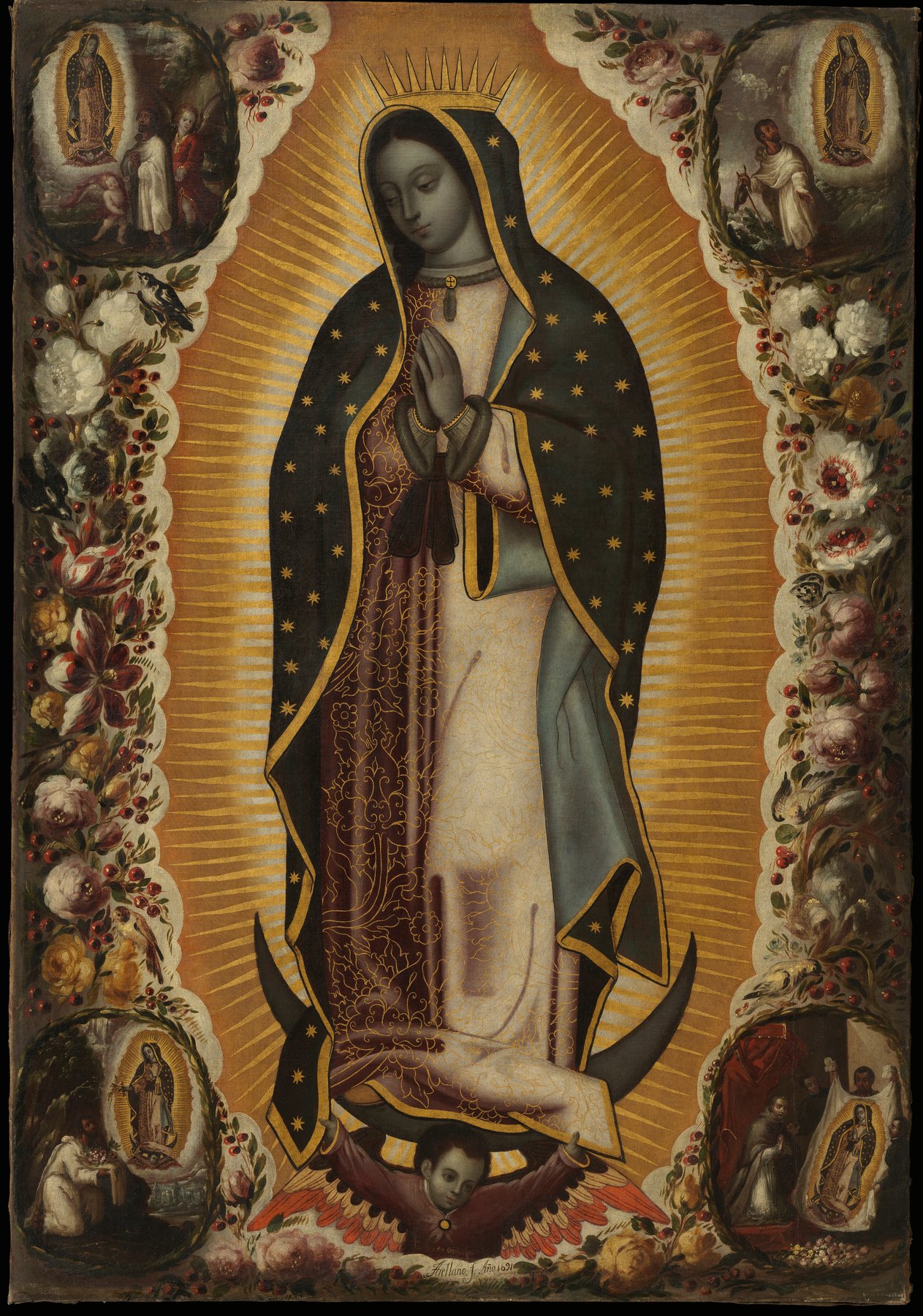
Virgin of Guadalupe
1691 · Oil on canvas · Los Angeles County Museum of Art
For Our Lady of Guadalupe · 12 December
Sizes
image 7×10 in on a 8×10 in sheet
What is dpi?
Dots per inch: how many pixels of the museum’s file go into each inch of paper. Our floor is 240 for sheets up to 20 inches, 180 up to 36 inches and 120 beyond, because a larger print is seen from further away. We never offer a sheet below the floor, and the number on each size is the one you receive.
Hahnemühle Photo Rag, 308 gsm cotton rag · pigment inks · printed to order
Printed to order · the whole painting, never cropped · if it arrives damaged, we replace it
Free shipping, included in the price, to all eight countries we ship to. Dispatched in 2–4 working days — nothing to send back if it arrives damaged.
Send as a gift
A printed card goes in the parcel with your message and the work’s museum record. No price is shown anywhere in the parcel. Enter the recipient’s address at checkout.
0 / 240Have a gift certificate?
The certificate’s balance is applied at checkout; any remainder is paid there. Check a balance or buy one.
Christmas: order by Monday 7 December for delivery in the United States before Christmas.
All editionsAbout this painting
Flowers spill across a bishop's floor in the lowest corner, and that small spill is the whole proof. Antonio de Arellano and his son Manuel painted Our Lady of Guadalupe in 1691 as Mexico City venerated her: hands joined, mantle sown with stars, a crown above, the moon beneath her and an angel with spread wings bearing up her hem, the rays of her light ringed by a mandorla of flowers. Four roundels tell what LACMA's Ilona Katzew sets out: her appearances to Juan Diego on the hill of Tepeyac in 1531, ending where he unfolds his cloak before Bishop Juan de Zumárraga and her image is found printed on it. Juan Correa had made a waxed-paper template after that cloak so painters could copy her true, and on the lower edge the Arellanos wrote tocada a la original, touched to the original. She keeps her hands joined, and keeps them joined for us.
Sources: Los Angeles County Museum of Art, collections record M.2009.61 · Unframed, LACMA, 12 Dec 2011