

Drag the print to move it. The painting is shown at true scale; where its shape differs from the sheet the print has a paper border, not drawn here. Prints are sold unframed, and a frame here is only for planning.
St Serapion
1628 · Wadsworth Atheneum Museum of Art, Hartford
Sizes
image 11×12.6 in on a 11×14 in sheet
The museum’s file supports 11×14 in at 285 dpi; a larger sheet would fall below our floor.
What is dpi?
Dots per inch: how many pixels of the museum’s file go into each inch of paper. Our floor is 240 for sheets up to 20 inches, 180 up to 36 inches and 120 beyond, because a larger print is seen from further away. We never offer a sheet below the floor, and the number on each size is the one you receive.
Hahnemühle Photo Rag, 308 gsm cotton rag · pigment inks · printed to order
Printed to order · the whole painting, never cropped · if it arrives damaged, we replace it
Free shipping, included in the price, to all eight countries we ship to. Dispatched in 2–4 working days — nothing to send back if it arrives damaged.
Send as a gift
A printed card goes in the parcel with your message and the work’s museum record. No price is shown anywhere in the parcel. Enter the recipient’s address at checkout.
0 / 240Have a gift certificate?
The certificate’s balance is applied at checkout; any remainder is paid there. Check a balance or buy one.
Christmas: order by Monday 7 December for delivery in the United States before Christmas.
All editionsAbout this painting
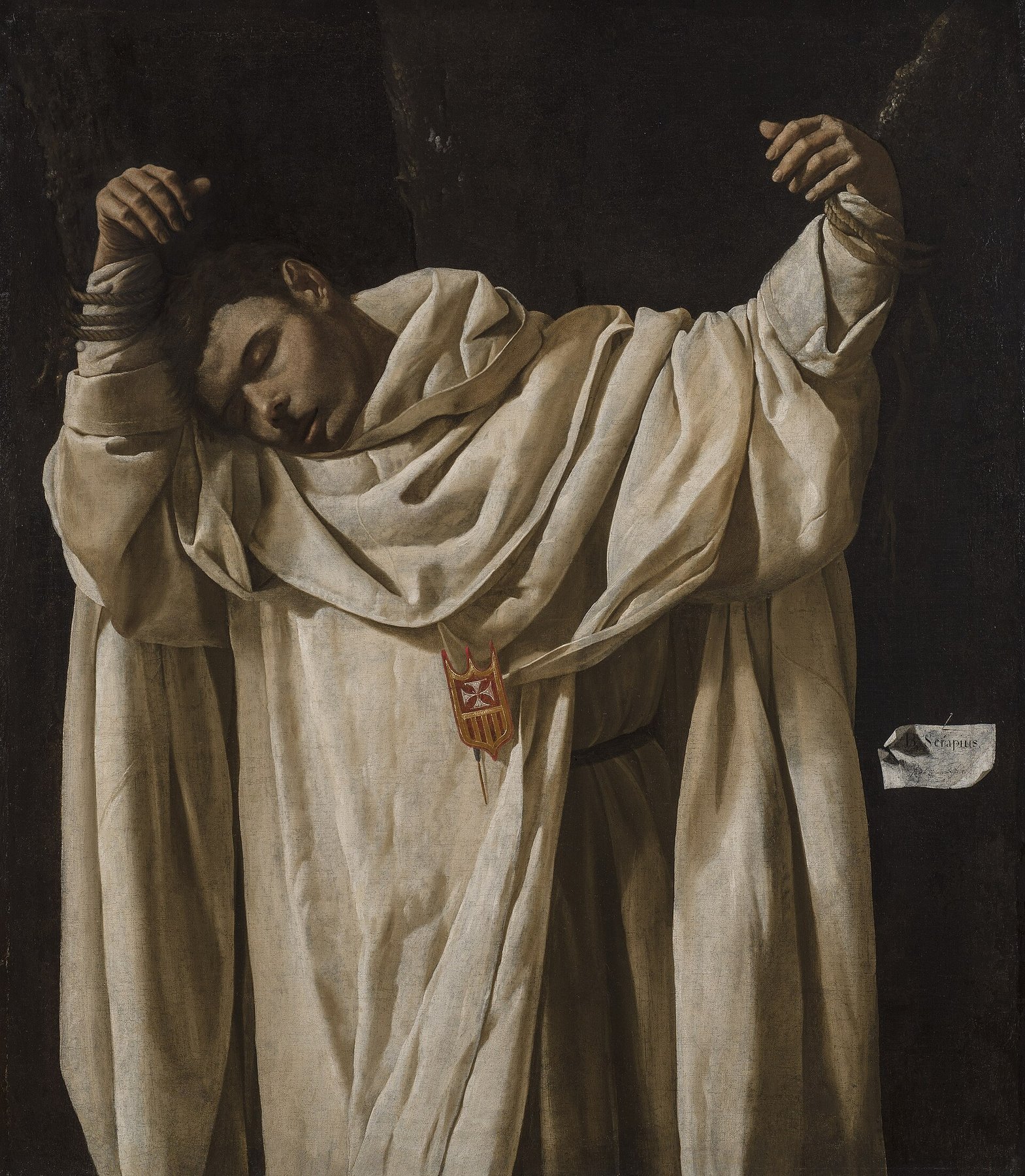
A friar hangs by his wrists, tied with rope to something we cannot see, and his head has fallen onto his shoulder. His eyes are closed. There is no blood. Zurbarán painted Serapion in 1628, Jeannine Baticle records, for the Sala de Profundis of the Mercedarian house in Seville, the room where dead friars were laid out before burial. The Mercedarians took a fourth vow, to give themselves up as hostages for Christians held captive, and Serapion kept it to death. Melisa Palermo notes that the white habit hides the violence done to him, and that the order's badge on his breast is the only colour in the painting. A small paper pinned beside him names him, Baticle says, Blessed Serapius; he was canonised in 1728. The white keeps its silence. The badge speaks for him.
Sources: Jeannine Baticle, Zurbaran, Metropolitan Museum of Art, 1987, cat. 5 · the fourth vow, in the order’s own words · conservation, acquisition 1951 · Melisa Palermo, 'Francisco de Zurbarán, The Martyrdom of Saint Serapion', Smarthistory.