

Drag the print to move it. The painting is shown at true scale; where its shape differs from the sheet the print has a paper border, not drawn here. Prints are sold unframed, and a frame here is only for planning.
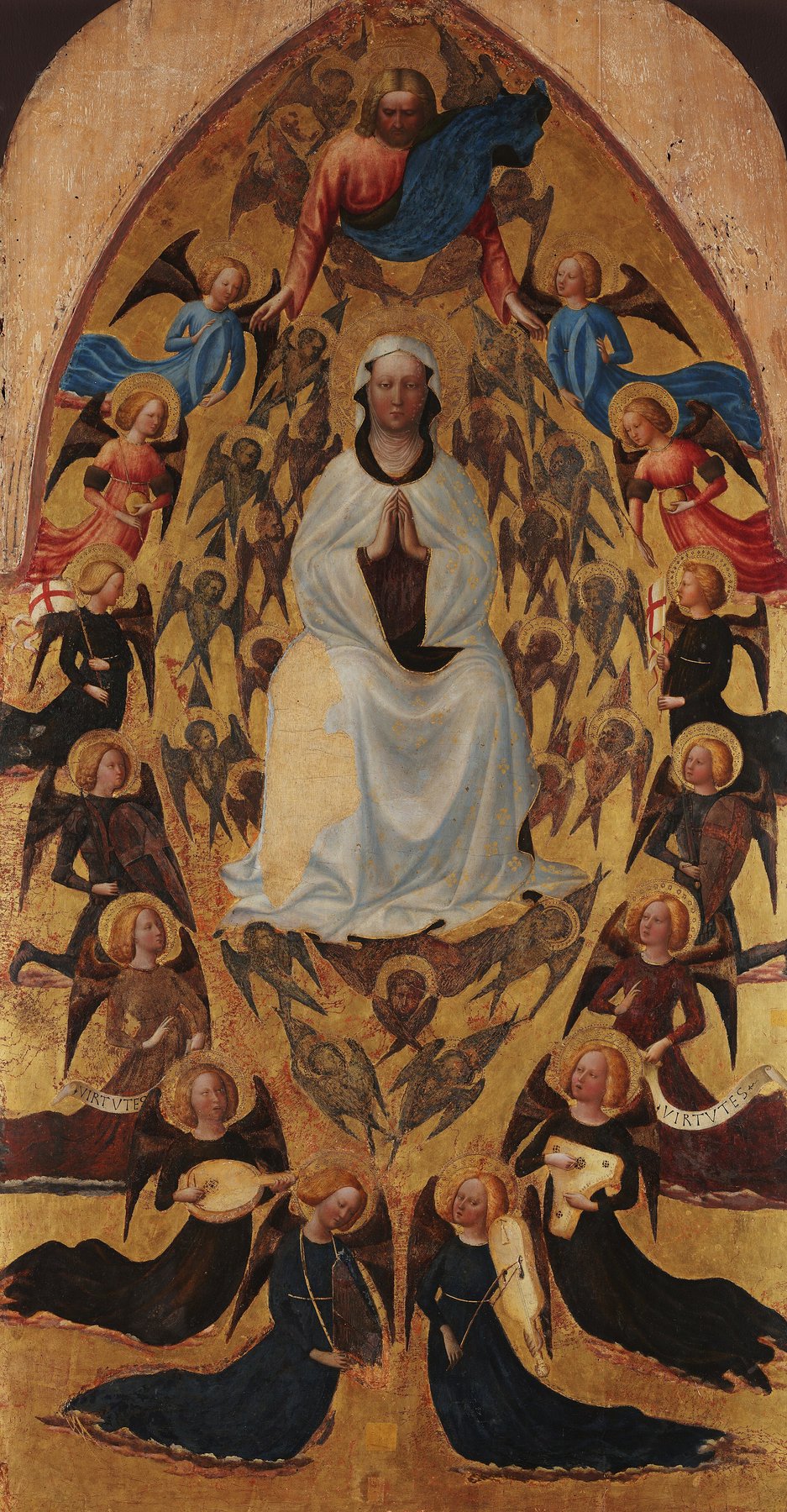
The Assumption of the Virgin
c. 1428 · tavola/ pittura a tempera (panel, tempera painting) · Museo di Capodimonte, Napoli (Collezione Farnese; Ministero della Cultura, Catalogo generale dei Beni Culturali)
For the Assumption · 15 August
Sizes
image 12.5×24 in on a 18×24 in sheet
What is dpi?
Dots per inch: how many pixels of the museum’s file go into each inch of paper. Our floor is 240 for sheets up to 20 inches, 180 up to 36 inches and 120 beyond, because a larger print is seen from further away. We never offer a sheet below the floor, and the number on each size is the one you receive.
Hahnemühle Photo Rag, 308 gsm cotton rag · pigment inks · printed to order
Printed to order · the whole painting, never cropped · if it arrives damaged, we replace it
Free shipping, included in the price, to all eight countries we ship to. Dispatched in 2–4 working days — nothing to send back if it arrives damaged.
Send as a gift
A printed card goes in the parcel with your message and the work’s museum record. No price is shown anywhere in the parcel. Enter the recipient’s address at checkout.
0 / 240Have a gift certificate?
The certificate’s balance is applied at checkout; any remainder is paid there. Check a balance or buy one.
Christmas: order by Monday 7 December for delivery in the United States before Christmas.
All editionsAbout this painting
Our Lady rises in a white mantle with her hands joined, and the angels around her are packed as close as feathers; some play lute and viol, and two carry scrolls lettered Virtutes. Dillian Gordon's National Gallery catalogue, citing Perri Lee Roberts, reads these angels as the nine hierarchies as Gregory the Great ranked them, with a pope, whom the National Gallery names only tentatively as Saint Gregory, placed alongside. Masolino painted this about 1428 as one face of a shared support. The other face showed the miracle that founded Santa Maria Maggiore, an August snowfall tracing the basilica's plan on the Esquiline Hill: the church founded on earth on one side, and on the other Mary taken up into heaven. By 1644 the two faces were sawn apart at Palazzo Farnese and called Fra Angelico. The angels still bear her up.
Sources: National Gallery, London, Gordon 2003, 'Santa Maria Maggiore Altarpiece' catalogue entry · National Gallery, London, Gordon 2003 (commission history) · National Gallery, London, Gordon 2003 · Strehlke and Tucker technical study, cited in National Gallery, London, Gordon 2003 · National Gallery, London, Gordon 2003 (dispersal history) · The National Gallery, London, Masolino, 'A Pope (Saint Gregory?) and Saint Matthias', NG5963.