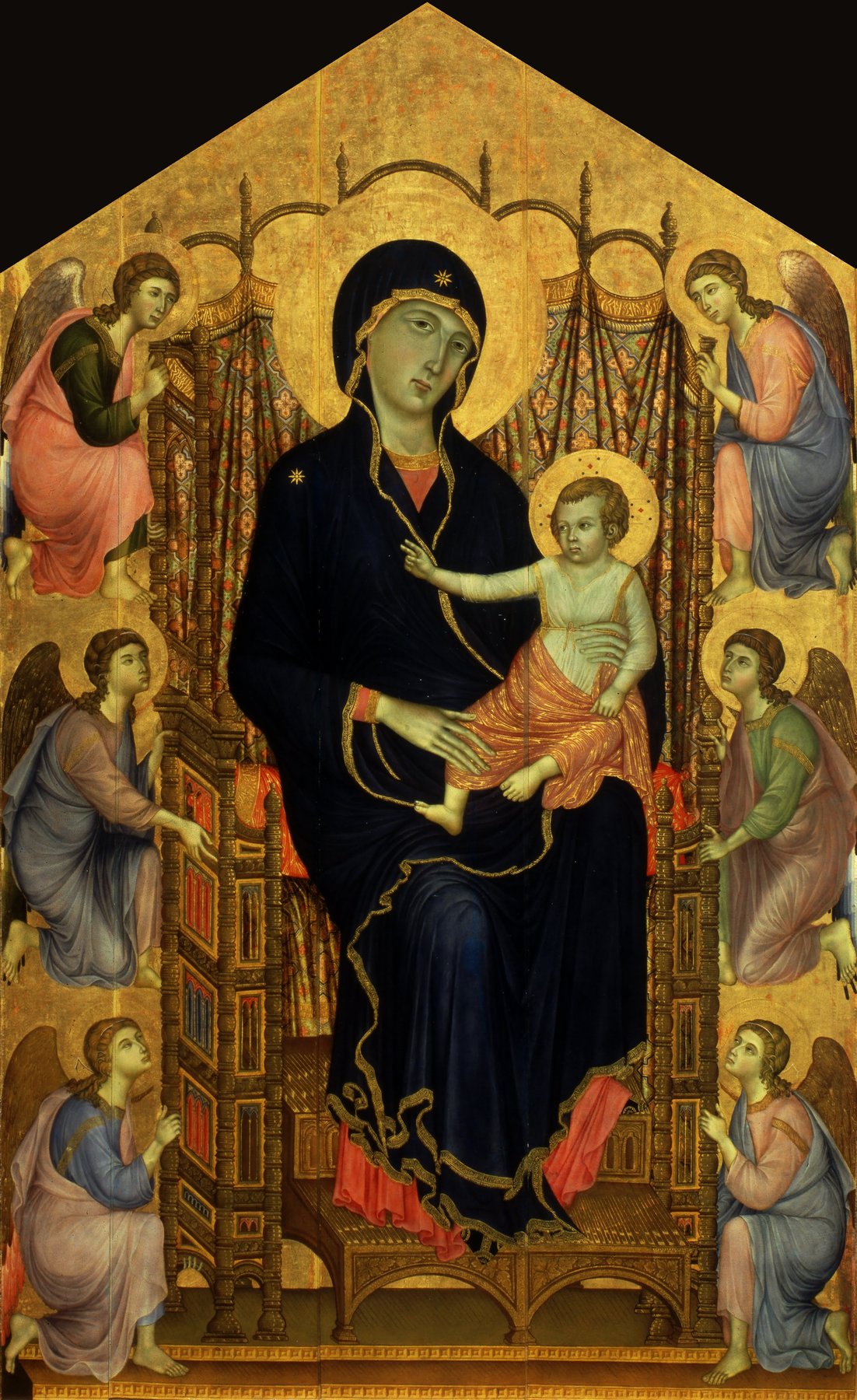
The Maestà
The original, as its museum records it
Every line above is reproduced from the holding institution’s own catalogue entry, which is linked. Where their title, date or attribution differs from ours, theirs is the one printed here.
The file this print is made from
Sizes
About this painting
Siena had handed the Virgin its keys and minted coins calling itself the city of the Virgin. This is her throne room, and the four saints kneeling closest are the city's own patrons, come as a delegation.
Only these four kneel, and Duccio wrote their names beside them: the supplication has signatories. The Virgin's answer is to incline her head toward the Child she holds, indicating him, not herself.
At the foot of the throne he wrote not a signature but a prayer: be the cause of peace for Siena, and life to Duccio, because he painted you thus.
Sources: Museo dell'Opera del Duomo, Siena (Opera della Metropolitana) · Dillian Gordon, National Gallery Catalogues: The Italian Paintings before 1400 (London, 2011), 'Maestà Predella Panels' · the Archivio di Stato payment of 30 June 1311 to four city trumpeters for the transport of the picture from the workshop to the high altar · Charles Eliot Norton, Historical Studies of Church-Buildings in the Middle Ages (New York: Harper & Brothers, 1880), 144–45, translating G. Milanesi, Documenti per la storia dell'arte senese, I (Siena, 1854), 169 · the keys of the city placed in the Virgin's hands before Montaperti, 1260, and the coins struck 'Sena vetus civitas Virginis' · Web Gallery of Art, 'The Maestà (1308-11)', Siena. · Giuseppe Nifosì, 'La Maestà del Duomo di Siena di Duccio', Arte Svelata.
Printed on demand. Public-domain masterwork, reproduced from a 4,248 px master of the original. The whole image is printed — never cropped to fit the sheet — so every sheet carries an archival margin, and the dimensions and resolution listed above are the ones you receive.