
Drag the print to move it. The painting is shown at true scale; where its shape differs from the sheet the print has a paper border, not drawn here. Prints are sold unframed, and a frame here is only for planning.
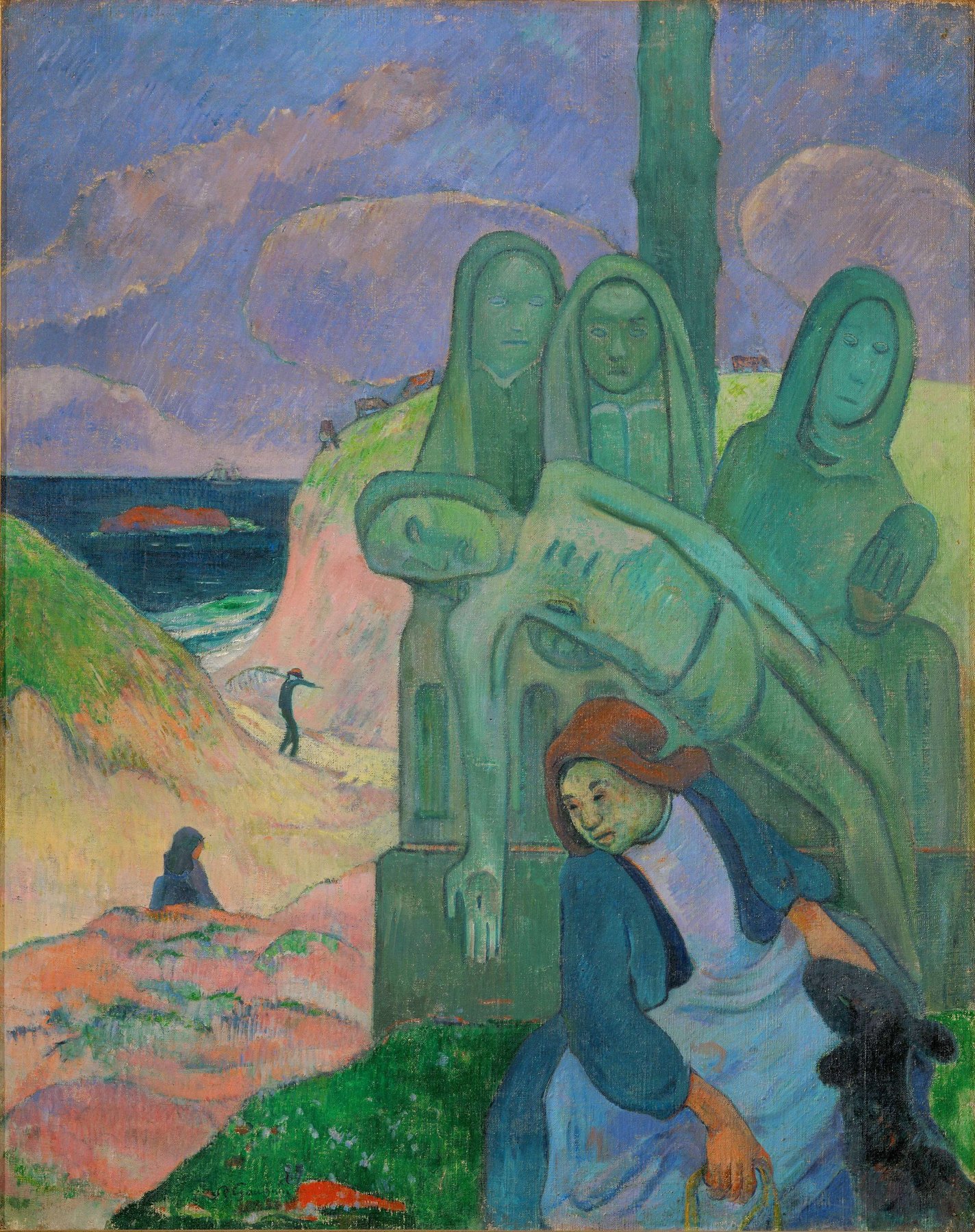
The Green Christ (Le calvaire breton)
1889 · Huile sur toile (oil on canvas) · Royal Museums of Fine Arts of Belgium, Brussels
For Our Lady of Sorrows · 15 September
Sizes
image 7.9×10 in on a 8×10 in sheet
What is dpi?
Dots per inch: how many pixels of the museum’s file go into each inch of paper. Our floor is 240 for sheets up to 20 inches, 180 up to 36 inches and 120 beyond, because a larger print is seen from further away. We never offer a sheet below the floor, and the number on each size is the one you receive.
Hahnemühle Photo Rag, 308 gsm cotton rag · pigment inks · printed to order
Printed to order · the whole painting, never cropped · if it arrives damaged, we replace it
Free shipping, included in the price, to all eight countries we ship to. Dispatched in 2–4 working days — nothing to send back if it arrives damaged.
Send as a gift
A printed card goes in the parcel with your message and the work’s museum record. No price is shown anywhere in the parcel. Enter the recipient’s address at checkout.
0 / 240Have a gift certificate?
The certificate’s balance is applied at checkout; any remainder is paid there. Check a balance or buy one.
Christmas: order by Monday 7 December for delivery in the United States before Christmas.
All editionsAbout this painting
The stone has gone green with the weather, and so has the Christ laid across the laps of the three holy women, carved in one block with them. A Breton woman in a dark dress crouches at the foot of the calvary with a dark lamb under her arm, her face turned toward the sea; a man crosses the beach below with a load on his shoulder, and the dunes are pink. Paul Gauguin painted it at Pont-Aven in 1889, the year of the Yellow Christ, and signed it at the lower left. The Royal Museums of Fine Arts of Belgium, which bought it in Brussels in 1922, keep it under his own title, Le calvaire breton. Calvaries like this one stand at crossroads all over Brittany, and the people pass them every day. The woman is not praying. She is simply there, beside the dead Christ, with her animal, as her grandmothers were. The sculpture holds him up for her.
Sources: Musées royaux des Beaux-Arts de Belgique, 'Le calvaire breton', Inv. 4416; read 2026-10-15. · Buffalo AKG Art Museum, 'Le Christ jaune', 1946:4; read 2026-10-15.