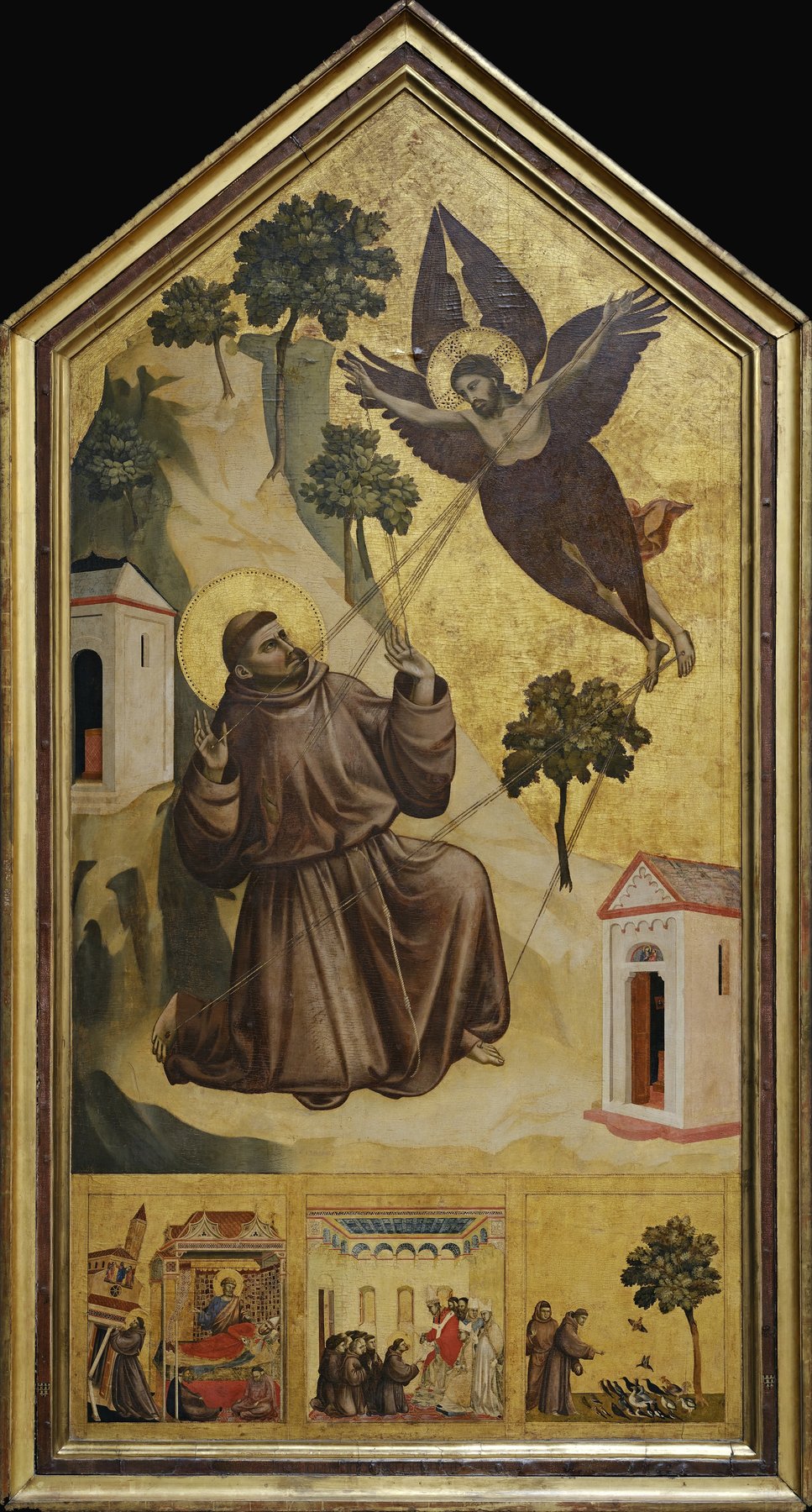
St Francis Receiving the Stigmata
The original, as its museum records it
Every line above is reproduced from the holding institution’s own catalogue entry, which is linked. Where their title, date or attribution differs from ours, theirs is the one printed here.
The file this print is made from
Sizes
About this painting
The figure in the air is not an angel. It is a six-winged seraph, with a crucified man between the wings, and Bonaventure says Francis did not understand what it meant.
Then Giotto does something a photograph could not: he draws the gold lines. Rays run from each of Christ's wounds to the matching place on Francis, and they cross, so the right wound arrives at the left hand. It is a diagram of cause, painted.
The panel bears a signature — Opus Iocti florentini. Napoleon's commissioners took it from Pisa in 1812.
Sources: Musée du Louvre, INV 309 ; MR 253 · Donal Cooper, "Redefining the Altarpiece in Early Renaissance Italy: Giotto's Stigmatization of Saint Francis and its Pisan Context," Art History 36, no. 4 (2013), 686–713 · M. R. Lanfranchi, "Giotto's Stigmatization of Saint Francis: An Approach for the Reconstruction of the Image" (2019) · The National Gallery, London, on recognising saints by the stigmata
Printed on demand. Public-domain masterwork, reproduced from a 11,017 px master of the original. The whole image is printed — never cropped to fit the sheet — so every sheet carries an archival margin, and the dimensions and resolution listed above are the ones you receive.