

Drag the print to move it. The painting is shown at true scale; where its shape differs from the sheet the print has a paper border, not drawn here. Prints are sold unframed, and a frame here is only for planning.
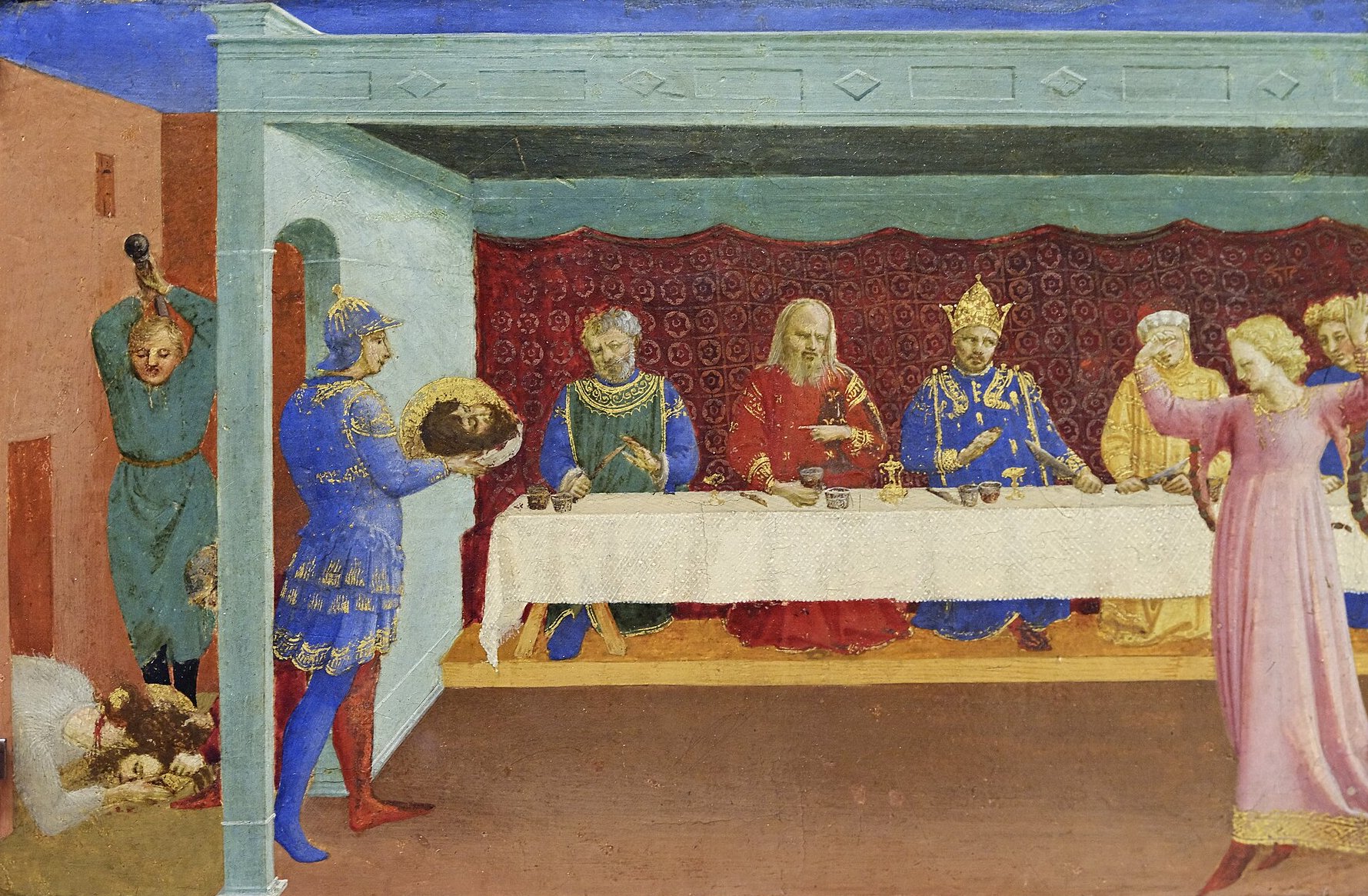
The Beheading of Saint John the Baptist and the Feast of Herod
c. 1430 · bois (peuplier) — surface peinte coupée sur la gauche (wood (poplar); the painted surface cut down on the left) · Musée du Louvre, Paris
For the Passion of Saint John the Baptist · 29 August
Sizes
image 20×13.1 in on a 20×16 in sheet
What is dpi?
Dots per inch: how many pixels of the museum’s file go into each inch of paper. Our floor is 240 for sheets up to 20 inches, 180 up to 36 inches and 120 beyond, because a larger print is seen from further away. We never offer a sheet below the floor, and the number on each size is the one you receive.
Hahnemühle Photo Rag, 308 gsm cotton rag · pigment inks · printed to order
Printed to order · the whole painting, never cropped · if it arrives damaged, we replace it
Free shipping, included in the price, to all eight countries we ship to. Dispatched in 2–4 working days — nothing to send back if it arrives damaged.
Send as a gift
A printed card goes in the parcel with your message and the work’s museum record. No price is shown anywhere in the parcel. Enter the recipient’s address at checkout.
0 / 240Have a gift certificate?
The certificate’s balance is applied at checkout; any remainder is paid there. Check a balance or buy one.
Christmas: order by Monday 7 December for delivery in the United States before Christmas.
All editionsAbout this painting
A soldier carries a head on a gold platter, and at the long table the supper goes on. Behind him an arm is still raised over the body of Saint John the Baptist; ahead, the cloth is laid and the cups are out. Saint Mark tells it without ornament: "But sending an executioner, he commanded that his head should be brought in a dish." A girl in pink dances. Carved alone, head and platter became what Barbara Baert calls a "substitute liturgical object during the veneration of the Host." Fra Angelico sets one doorway between the cell and the feast. The dish crosses it.
Sources: Explains the 'continuous narrative' (istoria continua) device used to separate/unite successive moments of one story via architecture, as used in this composition type · Louvre catalogue record for RF 196 confirming medium (tempera on poplar), object type (predella element), and attribution to Fra Angelico · Barbara Baert (KU Leuven), 'Vox clamantis in deserto: The Johannesschüssel', Open Arts Journal 4 (2014). · Mark 6:22-26, Douay-Rheims (Challoner).
But sending an executioner, he commanded that his head should be brought in a dish.
Mark 6:27 · Douay-Rheims (Challoner)