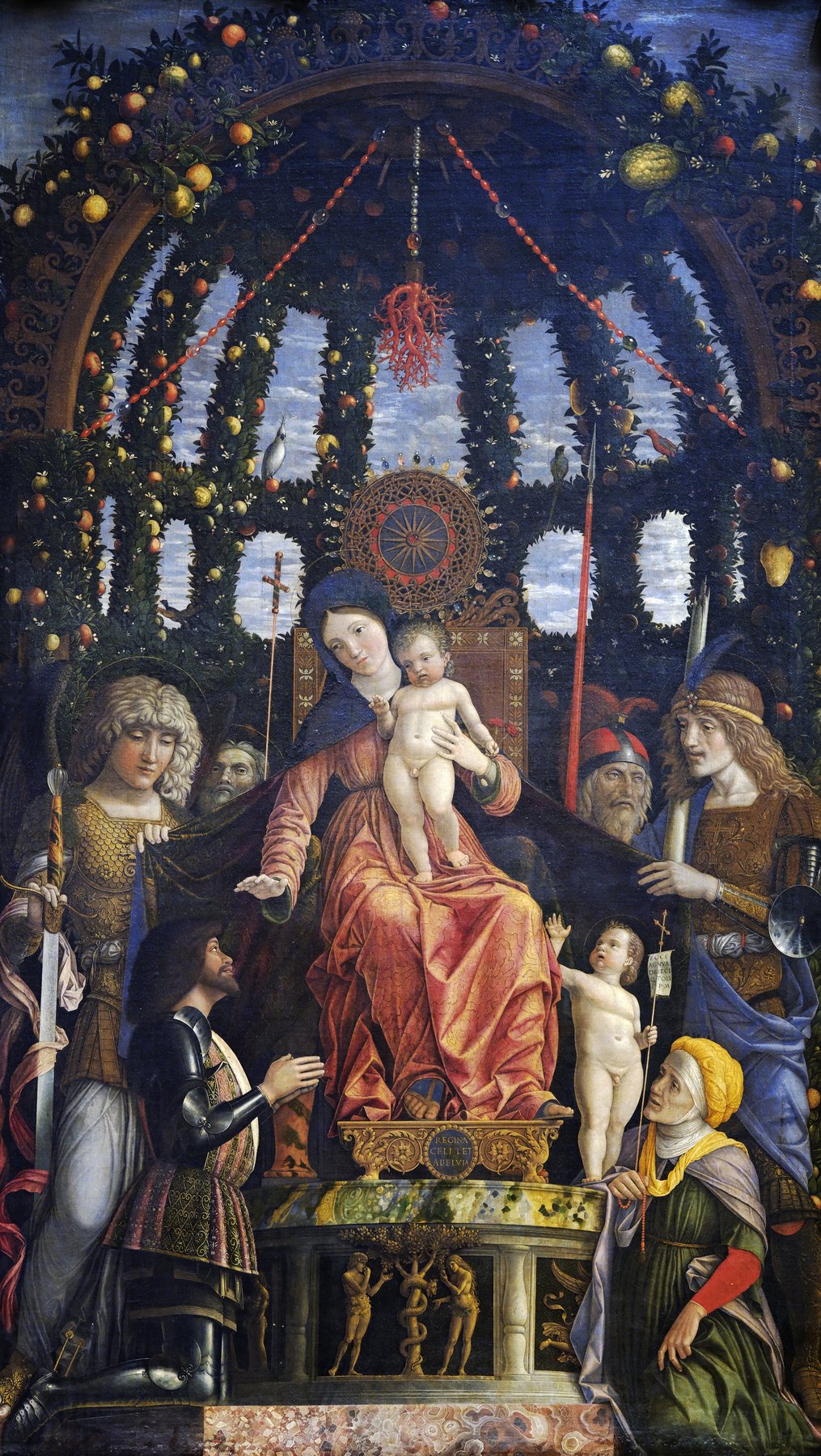
The Madonna della Vittoria
The original, as its museum records it
Every line above is reproduced from the holding institution’s own catalogue entry, which is linked. Where their title, date or attribution differs from ours, theirs is the one printed here.
The file this print is made from
Sizes
About this painting
An ex-voto is a receipt. Francesco Gonzaga kneels in armour, thanking the Virgin for Fornovo — a victory the Louvre calls doubtful — under a bower of lemon and orange trees full of birds. Heather Dalton identifies one as a sulphur-crested cockatoo, from life or a portrait made abroad.
Rodolfo Signorini reads the throne's painted reliefs as Genesis: the Fall, the expulsion, the Child above the sin he came to undo.
Gonzaga did not pay. Susan May names the payer: Daniele da Norsa, a Jewish banker whose house was taken for the chapel, made to pay the considerable expenses.
Sources: Musee du Louvre, collections database, INV 369 ; MR 337, La Vierge de la Victoire. · Musee du Louvre, Mantegna exhibition mini-site, Madonna della Vittoria. · Rodolfo Signorini, 'The Creation of Adam: A Detail in Mantegna's Madonna della Vittoria', JWCI 59 (1996), 303-304. · Heather Dalton, 'A Sulphur-crested Cockatoo in fifteenth-century Mantua', Renaissance Studies 28.5 (2014). · Mantova Museo Urbano Diffuso, 'Madonna della Vittoria', Google Arts & Culture. · Susan May, 'Pruning and propagating civic behaviour: three feste in and around Santa Maria della Vittoria in Mantua, 1495-97', in Architecture, Festival and the City (Routledge, 2018), 17-34.
Printed on demand. Public-domain masterwork, reproduced from a 9,137 px master of the original. The whole image is printed — never cropped to fit the sheet — so every sheet carries an archival margin, and the dimensions and resolution listed above are the ones you receive.